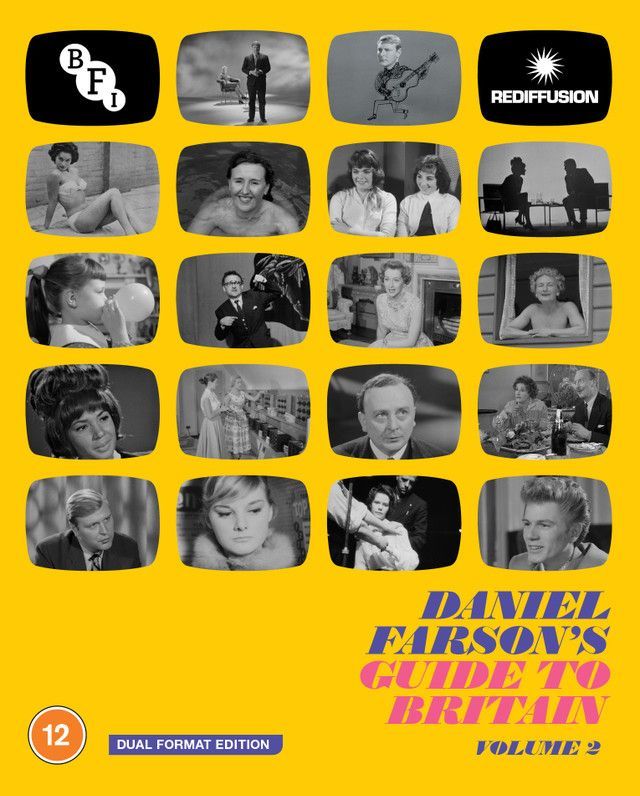
Daniel Farson's Guide To Britain vol 1
Daniel Farson's Guide To Britain Vol 1
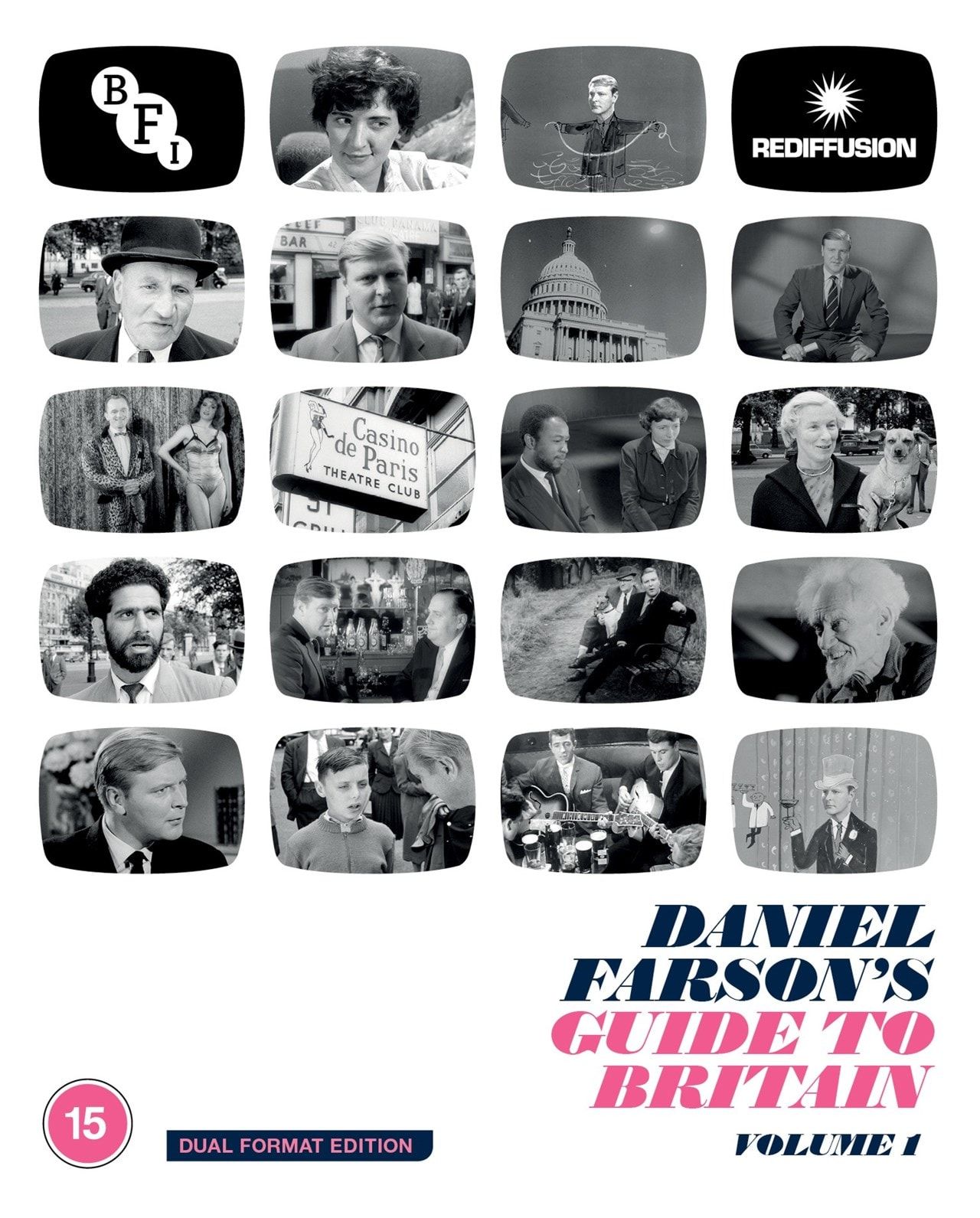
Daniel Farson’s Guide to Britain Vol1 BFI DVD/BluRay dual format disc
Out now from those archive raiders the BFI, comes a treasure trove of short programmes from our televisual past, taking serious and frivolous subjects hosted by the famously bohemian and bibulous broadcaster and journalist Daniel Farson.
In our present age when the viewer wonders whether any subject is considered off-beat, we can look back on a Britain when convention was all and anyone who stepped out of line was an anomaly, a crank or even a dangerous eccentric.
First up is an offering from ‘Out Of Step’ and Farson’s interviews with luminaries of the occult world. With the Witchcraft Act of 1951 ending the legal classification of witchcraft as a crime and instead seeking to punish those who used pretended magical powers for monetary gain, some people went public with their occult beliefs. Here, Farson interviews the wild-haired Gerald Gardner, whose impish sense of humour may have put more viewers off him than endeared him to them. Estimating as many as four hundred witches in Britain a that time, presumably including those in his Isle of Man home, his enthusiasm for rituals in the nude and his doubting Thomas attitude to witches’ use of wax images and cursing in general keeps us well entertained. Next up is renowned Egyptologist and archaeologist Dr. Margaret Murray, whose extensive work on folklore earned her the name ‘The Grandmother of Wicca’. Downplaying the idea that witches may have actual magical powers, Dr. Murray does confirm she met a witch once (probably far more than one) and felt her a dangerous person. Louis Wilkinson recalled his friendship with magician Aleister Crowley – here mis-identified a witch – and the over-reaction of the local press at his reading of Crowley’s ‘Hymn to Pan’ at Crowley’s funeral in an undenominational crematorium in Brighton.
If witches and magicians are a little beyond your comfort zone, ‘Keeping In Step’ might be more to your taste. The rituals of the British wedding, religious, secular and financial are examined with comments from the happy couples and the parents footing the bill. Passing on to another subject steeped in ritual and driven by money, the Stock Market is shown to be a world away from the electronic labyrinth of today. The Stock Exchange here looks more like a gentleman’s club than an international investment hub, the members with their well-defined roles in the daily drama, where a man’s word was his bond. I use the male gender here with good reason, as women were only admitted as members in 1973.
Farson was no stranger to Soho and his investigation into the striptease clubs of that notorious area is effortless. Costing the average punter membership as well as inflated prices for drinks, the shows rarely kept their teasing promises of full nudity, although they did, indeed, move. Most revealing are the interviews with the strippers who giggle their way through Farson’s questions and come across as professionals rather than the desperate young women the ‘clean-up’ campaigners often tried to characterize them as.
‘Success Story’ shows Farson speaking to playwright Shelagh Delaney, whose play ‘A Taste of Honey’ was enjoying phenomenal success. Shelagh comes across well, sticking to her down-to-earth approach to life and work and deftly parrying Farson’s more salty questions. With an assurance that only comes from youth, she dismisses fellow, more experienced playwrights’ efforts and cleverly avoids being drawn into a North/South divide trap.
By way of total contrast, Farson’s interview with Robert Graves seems fusty and halting, the irascible poet’s dislike of the modern world, home comforts for young people and the welfare state puts him at odds with the age he lived in; in other words, the perfect Aunt Sally for Farson to subtly throw coconuts at. Asked for his advice to young writers, Graves felt that a good writer would somehow manage to make a career. I wonder how many writers, lacking his background and advantages, would agree with that, then and now.
Farson’s visit to Lundy Island feels more like a step into Doctor’s Who’s Tardis and a trip back fifty years in time, than an investigation into the lives of a group of people who have decided they no longer care for the rat race’. The hub of the island is the pub, where everyone meets to drink and talk about the day’s labours and life in general. Farming. sheep herding and gardening are the main activities and the islanders come from all walks of life. Some stay for only a short time, some for a few months of the year, some the whole time. The slow pace of life is perhaps a surprise, considering the level of manual work involved in daily life, but the people seems more than happy with their lot.
‘Out of Step’ continues with another outré subject, ‘Other Worlds Are Watching Us’. Interviews with Unidentified Flying Object enthusiasts like Brinsley le Poer Trench, editor of the flying Saucer Review and others, gives us a flavour of the polarized public attitude to the phenomenon of alleged ‘flying saucers’ and alien encounters. Another, claiming a visit on board a UFO in his subtle ‘etheric’ body rather than his physical one, rolls out the predictable experience beloved of today’s alien abductees. The Venusian women are very beautiful, he assures us. Most of the interview material here seems more like snippets from science fiction films of the time, rather than any evidence based theory. Astronomer Royal Sir Harold Spencer Jones states his views baldly and without any speculation, sticking only with what we know to be scientific fact. Whether the public of the time believed or not, there was no denying how mainstream the subject had become and how it continues to be so.
‘People In Trouble’ gave us more substantial fare, that of the then-termed ‘mixed marriages’. Farson interviews a group of people who are or were in a marriage with a person of a different race and what experiences they had had a result of it. The black husband of one marriage did not feel that he had experienced much prejudice and was optimistic about the future for his child. A white woman whose marriage had broken down blamed cultural differences rather than the attitudes of others. A well-educated and connected young black man also deflected the seriousness of prejudice, expressing a view that he would like to marry a white woman one day. Passing on to a middle aged white man, whose intolerant views would doubtlessly chime today with some members of the less fragrant parts of our political scene, is perhaps best taken with a clear head. John Grigg, otherwise Lord Altrincham, brings a welcome sense of relief, debunking the idea of any ‘pure’ race and arguing well for a more tolerant, inclusive Britain.
‘Success Story’ includes interviews with clairvoyant Maurice Woodruff, who could count actors Peter Sellers and Diane Cilento among his clients and Cliff Richard, at the height of his fame as a rock and roll singer. Woodruff’s alternating between suggesting he had the gift of clairvoyance from God and then denying he had any special powers at all was interesting, perhaps wary of the Fraudulent Mediums Act. A very self-assured and well-spoken 18 year old Cliff Richard proved one of Farson’s most interesting guests. Appearing to have his career drafted out already, he responded to Farson’s every question with a professionalism few people of his age could have.
‘Success story’ continues only in name as Farson eschews youthful playwrights and pop stars and instead focuses on one of the most popular pulp novelists of the period, the mysterious Mr. Hank Jansen. Interviewing Jansen’s publisher, a figure straight out of an edition of ‘Gideon’s Way’ and who had suffered a spell in chokey for the racy material he published, responds in best villain’s English to Farson’s questions. A highly successful enterprise, with a new volume appearing every month to massive sales response, he is cagey about Jansen himself, as is the warehouseman who handles the French-printed paperbacks. An interview is set up with the mysterious Mr. H.J. in a strip-bar which could be a set from ‘The Small World of Sammy Lee’. A man in a long trenchcoat and gangster’s fedora is seen waiting. We see he wears a rather crudely made mask and answers every question from Farson either guardedly or with a touch of the fantastical about it. Hugely entertaining, especially the ‘types’ the camera captures going about their work in the bar, Farson looks completely at home here, if perhaps a little disappointed in the results.
Apart from a bitty article about the apparent British obsession with cats, there is the marvelous ‘Beat City’, which takes in the Liverpool music scene of the times. The sweaty basements and brick vaults of legend are here, together with some of the bands who helped make this poor, run-down city legendary. Rory Storm and the Hurricanes and Gerry and the Pacemakers are among the best-known playing here, with a few whom musical history has passed by. The crowds are of course perilously young, out for fun and fearless as the young of every generation tend to be. The legendary Jacaranda is featured here, with Farson completely at home in its slightly gloomy atmosphere. The eagle-eyed among you may spot film of an audience of screaming girls in a Gerry and the Pacemakers clip, which has seen some service in other bands’ filmed appearances.
Travel back in time to the late 50’s / early 60’s for a taste of what television once was, and what it should be today.
Buy here:
https://www.bfi.org.uk/bfi-online-shop
Scenester
1 March 2026